
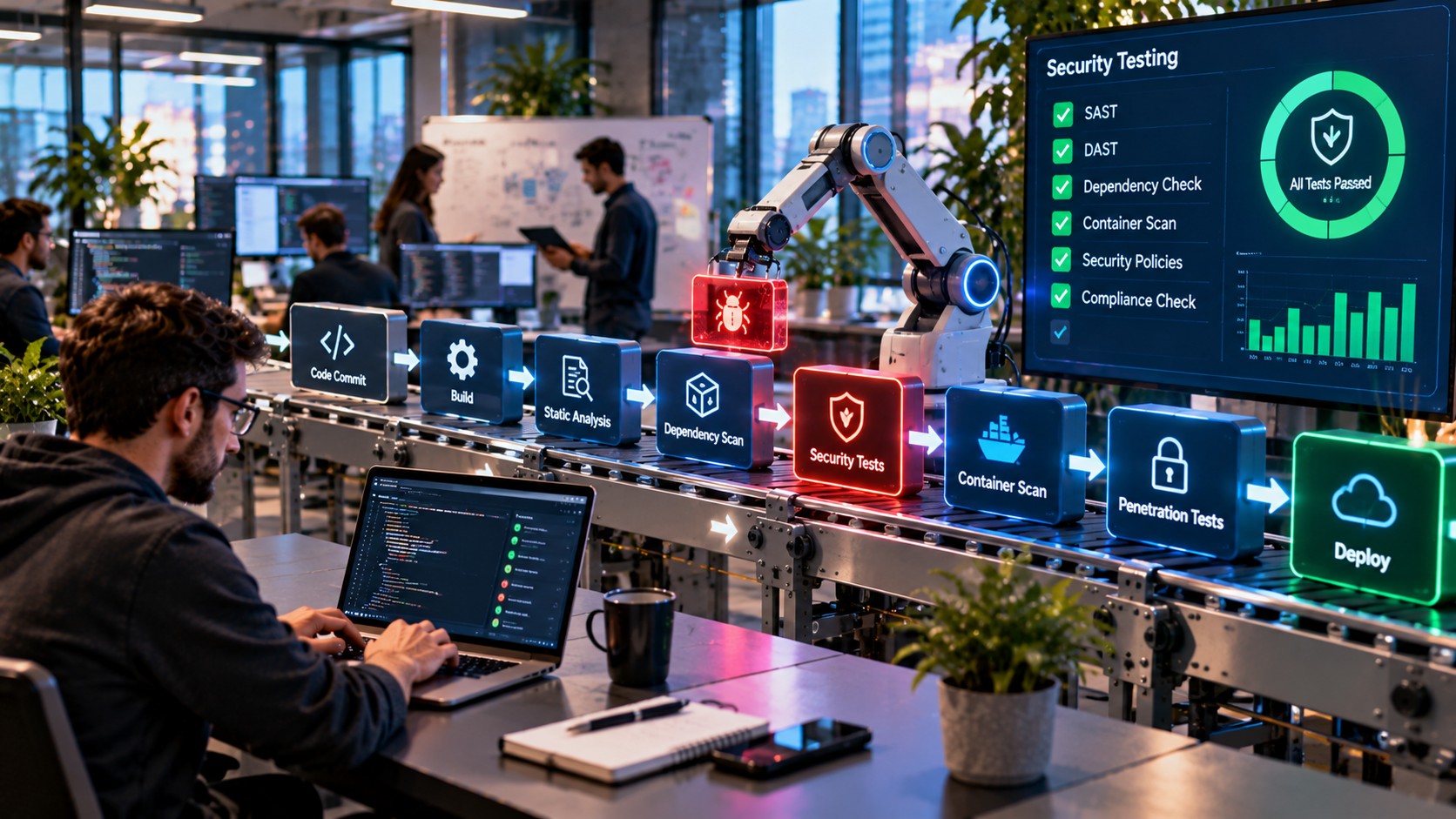
A cybersecurity product has an unusual responsibility: it must protect customers while also protecting itself. A vulnerability in a security platform can expose sensitive data, weaken detection capabilities, or undermine trust in the very technology designed to defend an organization.
That makes security testing more than a final checkpoint before release. It needs to become part of the software delivery process, running repeatedly as code, dependencies, infrastructure, and configurations change. DevOps provides the automation and workflow discipline needed to make that possible without turning every release into a manual security exercise.
Moving Security Checks Closer to Development
Traditional security testing often happens late in the development cycle. By that point, vulnerabilities may already be deeply integrated into application code or infrastructure.
An automated approach shifts many checks toward the beginning of the delivery pipeline. Developers can receive feedback while changes are still relatively small and easier to correct.
Static application security testing, dependency analysis, secret detection, configuration validation, and container scanning can all be integrated into automated workflows.
For organizations building security software, DevOps for cybersecurity products creates a framework where these checks become repeatable parts of delivery rather than occasional audits.
Building Multiple Layers of Automated Testing
Static Analysis for Code-Level Risks
Static analysis examines source code without requiring the application to run. Automated scanners can identify potentially dangerous patterns, insecure functions, injection risks, or other weaknesses.
These tools work particularly well when triggered automatically after code changes. Teams can establish severity thresholds that determine whether a pipeline continues or requires investigation.
Dependency and Supply Chain Checks
Modern applications rarely consist entirely of internally written code. Open-source packages, frameworks, container images, and external libraries introduce additional components that need monitoring.
Automated dependency scanning can identify known vulnerabilities and outdated packages. Container image scanning can perform a similar role for packaged application environments.
This gives engineering teams an opportunity to address supply-chain risks before affected components reach production.
Testing the Application in Motion
Static analysis cannot identify every security problem. Some weaknesses only become visible when an application is running.
Dynamic testing can interact with deployed applications and examine their responses to unexpected or malicious input. API testing can also verify authentication, authorization, validation, and access-control behavior.
Temporary Environments Improve Coverage
Automated pipelines can create short-lived testing environments for security validation. These environments allow teams to run more extensive checks without interfering with production systems.
Once testing is complete, the environment can be removed automatically.
Infrastructure as code makes this model practical because the same environment definitions can be used repeatedly, reducing inconsistencies between test runs.
Security Gates Without Creating Delivery Bottlenecks
Security automation should not simply produce an endless stream of warnings.
Teams need clear policies defining which findings block deployment and which can be documented for later remediation. A critical vulnerability in an exposed authentication component may require immediate action, while a lower-risk issue in an isolated internal tool may follow a different process.
DevOps helps connect technical findings with delivery rules. Security gates can therefore be incorporated into CI/CD pipelines without requiring engineers to manually interpret every scan.
For companies that need additional infrastructure and automation expertise, external DevOps support can also help establish these pipelines and integrate security tooling into existing development workflows.
Protecting the Pipeline Itself
A security testing system is valuable only if the pipeline running it is trustworthy.
Build servers, repositories, credentials, artifact stores, and deployment systems can become attractive targets. Excessive permissions or poorly protected secrets may allow attackers to bypass otherwise effective security controls.
Pipeline security should therefore include least-privilege access, protected credentials, isolated build environments, signed artifacts where appropriate, and detailed audit logging.
Keep Test Results Actionable
Security findings should be stored in a way that allows teams to track recurring vulnerabilities and measure remediation progress.
Centralized reporting can connect findings with commits, builds, environments, and releases. This makes it easier to determine whether a vulnerability was introduced recently or has existed across several versions.
Continuous Testing After Deployment
Security testing should not stop when software reaches production. New vulnerabilities are discovered constantly, dependencies change, infrastructure evolves, and previously safe configurations can become risky.
Continuous scanning can monitor deployed images, dependencies, cloud configurations, and exposed services. Runtime monitoring can provide another layer by identifying suspicious behavior that pre-release testing could not predict.
DevOps for cybersecurity products makes this continuous model easier to maintain because testing, infrastructure management, deployment, and monitoring can operate as connected processes.
The result is a security engineering workflow where automated checks accompany software throughout its lifecycle. DevOps does not replace specialized security expertise, but it gives security teams a repeatable mechanism for bringing that expertise into development, deployment, and ongoing operations without relying entirely on manual intervention.